当我看到“people before strategy”时,第一感觉就是肯定是咨询公司为了自己的业务在夸夸其谈,没办法,他们擅长这些,时不时就要搞一些新的噱头出来,要不他们的业务很难持续下去。
但当看到《People Before Strategy: A New Role for the CHRO》一文时,才感觉到其实根本不是战略和人才谁先谁后的问题,而是到了该重新认识人才、重新认识HR的时候了。
以前曾经问过一位高管:你是想先看看你手里有什么资源再决定你去哪儿还是你先想好去哪儿再想办法去获取资源?
他当然说,我肯定是先想好去哪儿再去看看资源。
其实,很多人回答此类问题,都是出于面子。因为,即使他选择了后者,但当看到自己手里缺这少那时,不由自主的就会被自己的资源牵着鼻子从而进入了前者根据自己的资源选择去哪儿的范畴。
我们可以称之为“企业资源导向的战略惰性”,但想想我们自己,大多数人,不都是这样混日子的么?所以,很多企业做不大,成功的人总是凤毛麟角,其背后的道理本质上并无二致。
《People BeforeStrategy: A New Role for the CHRO》这篇文章的作者比较大拿,分别来自于麦肯锡的鲍达民(Dominic Barton)和光辉国际的丹尼斯·凯利(Dennis Carey)以及第一作者拉姆·查兰(Ram Charan)。
拉姆·查兰(Ram Charan)最近2年比较火主要是因为他说要把HR部门拆掉,那些跟钱有关的(诸如薪酬福利之类的)、操作性的事物都跟财务、IT等其他整合成一个共享服务中心向CFO(首席财务官)汇报,CHRO(首席人才官)则聚焦于人才、领导力、coaching之类的。然后,CFO、CHRO、CEO三个人组成一个小集团G3,共同制定战略、检视战略、执行战略。
在G3模式下,CHRO的价值主要体现在三个方面:预测结果、诊断问题并在人事方面提供解决方案。
不过,他们3个举得一个例子,我觉得挺好笑。
如果当时摩托罗拉的CHRO能够提醒其CEO,苹果开始挖他们的技术人员,摩托罗拉就有可能预测到iPhone的诞生。
感觉,他们3个为了达到目的,真的是拼命了。不过,这也说明,他们的G3模式确实把CHRO提到了一个极高的位置,这或许是HR从业人员的福音吧?所以,不要愤恨拉姆要把HR拆掉,拆掉是为了更好的未来!
而且,他们3个还在文章最后说了:3年,就可以给你一个全新的HR。
拉姆是真正为CEO服务的,他知道HR对于CEO完成自己的业绩承诺的意义所在,所以他期望能够在“人、财、物”三个方面实现“精英团队化”,让3个CXO级的人物组成一个“命运共同体”,而且这3个CXO要比其他的CTO之类的更核心,所以只要G3就够了,而不是G4、G5。
当其他员工埋首处理日常事务时,G3应高瞻远瞩,共同决定公司命运,并追踪执行中产生的任何问题,确保公司处于正轨。正是G3建立起了组织和经营成果之间的联系。
但反思一下,感觉他们这篇的文章标题还是有些扩张。他们的文章恰好说明了根本不是“People Before Strategy”,而是“战略为先”。
《重新定义人才:如何让人才转化为战略影响力》就是基于“战略为先”这一理念而写的一本书关于如何差异化的进行人才管理的书。
此书的三位作者首先批判了被一些咨询公司过分扩大的“人才先于战略”的说法,回归“人才服务于战略”的根本,但应避免过去那种一刀切式的传统人力资源管理体系,提出基于“差异化”思想的人力资源机制。
“差异化”,这个主要是因为企业的战略本身就是差异的,所以不可能存在同样的人力资源管理方式和内容。其实,此书的作者也蛮省事儿的,直接就把波特的战略理论罗列一下,解释了人才管理需要差异化的重要性,然后这个问题就解决了。毕竟战略这个东西,随便找个比较有权威的、能引入自己主题的就行了。
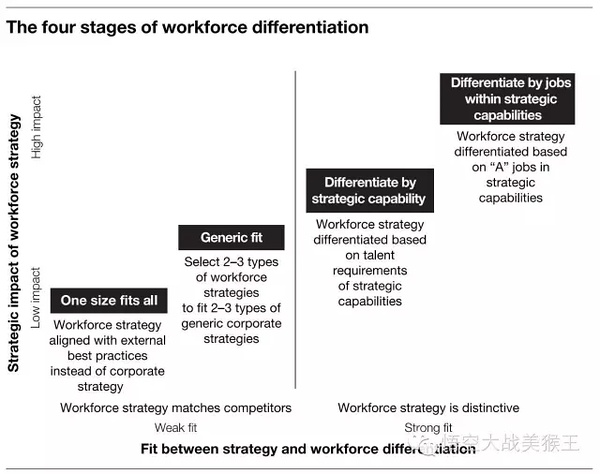
基于“成功的战略执行依赖于深度的人才差异化管理”的思路,作者提出一个人才管理差异化的四阶段模式,解释人才管理差异化和战略成功之间的关系。
如下图:
-
各章要点总结(看完这个就不用看书了,哈哈)
2014-03-17
Chapter 1: Reality vs. Perception
Management deals in reality. Facts, figures, charts and numbers. Management acknowledges the importance of perception, but believes that perception is just a reflection of reality. If you change the reality, you change the perception.
Marketing deals in perception. What matters to marketing people are not the “facts” of a situation but what’s in the mind of the consumer which may or may not correspond with reality. Changing reality is easy; changing perceptions is exceedingly difficult.
Chapter 2: Product vs. Brand
Management concentrates on the product. Management believes that nothing matters except the product. Building a better product is the objective of most chief executives.
Marketing concentrates on the brand. Marketing knows that you don’t win with a better product; you win with a better brand.
Chapter 3: Brand vs. Category
Management wants to own the brand. Management has jumped on the branding bandwagon and fallen in love with their brands. They keep looking for ways to take advantage of their brands by moving them into new categories.
Marketing wants to own the category. Consumers are in love with categories but express their category choices in terms of brands. The brand is the visible face of the category. If the category dies so does the brand.
Chapter 4: Better vs. Different
Management demands better products. Management has jumped on the branding bandwagon and fallen in love with their brands. They keep looking for ways to take advantage of their brands by moving them into new categories.
Marketing demands different products. Leaders are created by brands that are first in a new category. To create a new category and to be perceived as the innovator and leader, you have to think different not better.
Chapter 5: Full Line vs. Narrow Line
Management favors a full line. Common sense suggests that a full line of products and services allows you to sell more that if you had a narrow line.
Marketing favors a narrow line. Selling is the second step in a marketing program. The first step is building a brand in the mind. Building a brand with a full line can be difficult because you don’t stand for anything.
Chapter 6: Expansion vs. Contraction
Management tries to expand the brand. Growth is the number one goal of management. Logic suggests a company needs to expand its product line to continue that growth.
Marketing tries to contract the brand. In order in grow in profits, if not in sales, companies need to contract the brand rather than expand it. It may not sound logical but it works.
Chapter 7: First Mover vs. First Minder
Management strives to be the “ first mover.”
The first mover advantage is one of the most debated strategies in business. Moving first doesn’t guarantee your brand will get into the mind first. Managers often let opportunities slip through their fingers by failing to stay focused.
Marketing strives to be the “ first minder.”
In a new category the first brand that gets into the consumer’s mind is almost always the winner. Getting into the mind requires an understanding of consumer psychology as well as patience since it can take time to change minds.
Chapter 8: Big Bang vs. Slow Takeoff.
Management expects a “ big-bang ” launch. The enduring myth is that a new brand has to take off in a hurry (if it’s going to become a big brand.) This myth leads management to devote enormous resources to big-bang product introductions.
Marketing expects a slow take-off. Marketing intuitively knows that the more revolutionary the concept, the longer it is going to take to gain acceptance. And you can’t accelerate the process with massive marketing expenditures.
Chapter 9: Center vs. the Ends.
Management targets the center of the market. Management believes that if you want to build a big brand, then you need to target your products and services to the heart or sweet spot in the center of the market.
Marketing targets one of the ends. Marketing knows that the center or mushy middle is not the best place to be. The reality is that every category tends to diverge into two separate categories, one at the low end and one at the high end.
Chapter 10: Everything vs. a Word
Management would like to own everything. Management doesn’t want to get locked into a single word or concept since they want to appeal to everybody. Management is focused on delivering good experiences that consumers will remember.
Marketing would like to own a word. Marketers want to supply a single word that sums up the brand experience. Without associating a word with the brand, there is no way for a consumer to file the brand in the mind.
Chapter 11: Verbal Abstractions vs. Visual Hammers
Management deals in verbal abstractions. Management loves abstract slogans. Managers often elevate language until their words lose their meaning to the average person.
Marketing would like to own a word. Marketers want to supply a single word that sums up the brand experience. Without associating a word with the brand, there is no way for a consumer to file the brand in the mind.
Chapter 12: Single Brands vs. Multiple Brands
Management prefers a single brand. In an over-communicated society, it makes sense to put all your sales and marketing resources behind a single brand. And research supports the idea that consumers initially prefer known-brands to unknown brands.
Marketing prefers multiple brands. Growth is best achieved with multiple brands. Marketing knows that new names might not test well but are the key to building strong brands and dominating new categories.
Chapter 13: Cleverness vs. Credentials
Management values cleverness. Advertising that is interesting, appealing, clever and new is what management looks for when they evaluate advertising campaigns.
Marketing values credentials. Advertising that is relevant, motivating, familiar and consistent is what consumers look for when they are exposed to advertising campaigns.
Chapter 14: Double Branding vs. Single Branding
Management believes in double branding. If one brand is good, then two must be better, thinks management. A logical conclusion that can undermine a brand.
Marketing believes in single branding. Double-branding is resisted by marketing because consumers when given a choice will invariably use one name instead of two. Putting two names on a brand only confuses consumers.
Chapter 15: Perpetual Growth vs. Market Maturity
Management plans on perpetual growth. Targets and stretch goals are set and never-ending growth is demanded and assumed to be possible.
Marketing plans on market maturity. Never-ending growth is mathematically impossible. Sooner or later a mature brand reaches an optimum point where further growth can only come from population growth and inflation.
Chapter 16: Killing vs. Building Categories.
Management tends to kill new categories. A developing new category is a threat to an existing brand so management tries to put the kibosh on any potential new category from forming.
Marketing tends to build new categories. The best hope for a new company to compete with its larger competitors is by introducing a new brand that defines an emerging new category.
Chapter 17: Communication vs. Positioning
Management wants to communicate. The assumption is that a company sends the consumer an advertising message which the consumer listens to and believes.
Marketing wants to position. Advertising is about positioning not communications. What the best advertising does is to establish and reinforce a unique position in the mind.
Chapter 18: Long Haul vs. Short Haul
Management wants customers for the long haul. The goal is to create customers for life. The assumption is that a company will continue to change its products and services in order to satisfy the customer as he or she grows up.
Marketing is happy with a short-term fling. The goal is to keep the brand strong and focused even if that means letting customers go if they outgrow the brand.
Chapter 19: Coupons: Love them vs. Loath them
Management loves coupons and sales. For logical, rational thinkers, coupons seem like a no-brainer. Redemption rates and ROI are easily calculated.
Marketing loathes coupons and sales. Sales and coupons do two things neither of which are good. They tell your customers your regular prices are too high and not to buy from you again until you run a sale. Like crack cocaine, the highs of a sale can only be repeated by another sale.
Chapter 20: The Same vs. The Opposite
Management tries to copy the competition. The assumption is there is only one best strategy. Therefore a company can win by using the same strategy and then doing it better than the competition.
Marketing tries to be the opposite. There is no one best strategy. The best strategy all depends on the competition. The way to beat a market leader is not by copying its strategy but by using the opposite strategy.
Chapter 21: Existing Name vs. New Name
Management hates to change a name. When things go wrong, the last thing management blames is the name itself. It is always the fault of the product, the service, or the price.
Marketing often welcomes a name change. The most important marketing decision you can make is what to name the product. It is exceeding difficult to hang a positive perception on a negative name. The best way to deal with a bad name is to get rid of it.
Chapter 22: Constant Innovation vs. Sporadic Innovation
Management is bent on constant innovation. Management has elevated innovation to be the level of strategy and perhaps the single most important function of a corporation.
Marketing is happy with just one. Early on, innovation can help a company build a brand. But when a category matures, the opportunities for innovation generally dry up. Most brands don’t need more innovation; they need to figure out what they stand for.
Chapter 23: Multimedia: Hot vs. Not
Management has the hots for multimedia. Every time a new medium arrives, management thinks, What a great opportunity to extend our brand.
Marketing is not so sure. What looks like an opportunity usually turns out to be a line extension that leads to a loss of focus. The most successful brands in any new medium are new brands not crossovers from existing media.
Chapter 24: Short Term vs. Long Term
Management focuses on the short term. If you make your quarters, you’ll make your year. Management puts everything into its core brand no matter how many line extensions it takes, a strategy that may work today but which will undermine the brand in the future.
Marketing focuses on the long term. Sometimes you have to take one step backwards to take two steps forward. Marketing is a long-term proposition in which a new strategy can take years to bear fruit. Keep the core brand focused and deal with tomorrow by launching new brands.
Chapter 25: Common Sense vs. Marketing Sense
Management counts on common sense. Management approaches every situation in a sane, sensible way. Their emphasis is always on the product and the execution.
Marketing counts on marketing sense. The more experience a marketing person has the more he or she realizes that common sense is usually wrong. Often the illogical, uncommonsense “marketing idea” produces the best results.
-
理想丰满终究抵不过现实的骨感
2014-04-05
什么是品牌理想?
IDEAL (i-de’al), n. 1. The key to unlock the code for twentyfirst century business success. 2. The only sustainable way to recruit, unite, and motivate all the people a business touches, from employees to customers. 3. The most powerful lever a business leader can use to achieve competitive advantage. 4. A business’s essential reason for being, the higher-order benefit it brings to the world. 5. The factor connecting the core beliefs of the people inside a business with the fundamental human values of the people they serve. 6. Not social responsibility or altruism, but a program for profit and growth based on improving people’s lives.
卓越企业遵循的五项准则(必做的五件事):
Discover a brand ideal of improving people’s lives in one of fi ve fi elds of fundamental human values.
Build their organizational culture around the brand ideal.
Communicate the brand ideal to engage employees and customers.
Deliver a near- ideal customer experience.
Evaluate their progress and people against the brand ideal.
品牌理想树(Ideal Tree)各模块概述:
Discover
Uncover your brand purpose
Every business in the world has a potential growth-driving ideal at its center. You discover an ideal for a business by finding a link between its central reason for being, the core beliefs of its people, including senior leadership, and the fundamental values of customer.
While most businesses articulate a vision and a strategy, they often have not articulated—and activated—this is terms of a life-improving ideal. A Brand Ideal drives growth by inspiring employees and business partners to innovate and to perform at the highest levels.
The best Brand Ideals embody at least one of the five fundamental human values identified by Jim Stengel——
Eliciting Joy: Activating experiences of happiness, wonder, and limitless possibility
Enabling Connection: Enhancing the ability of people to connect with each other and the world in meaningful ways
Inspiring Exploration: Helping people explore new horizons and new experiences
Evoking Pride: Giving people increased confidence, strength, security, and vitality
Impacting Society: Affecting society broadly, from challenging the status quo to redefining categories
The most successful leaders express their Ideal explicitly, and often, with all stakeholders.
Define
Identify your unique selling proposition
Every business must be rooted in a clear understanding of how it achieves competitive advantage. To define this, you need to answer some strategic questions:
What category do you compete in?
Who are your primary competitors?
Who do you serve?
What benefit do you offer that emanates from your Ideal?
What are your essential points of difference vs. your rivals?
Where must you maintain competitive equality (points of parity)?
Answering these questions is critical to ideals-inspired brand building.
Build
Build an organizational culture around your Brand Ideal
Culture is the only sustainable competitive advantage. Inspiring and energizing people to work toward a common ideal can unleash their full potential. Leadership must set the tone for what they stand for and be clear about it, both internally and externally. All of your actions communicate culture.
10 “Culture Builders” unlock growth in people and business:
Reveal your inspirational Ideal and operationalize it
Be clear about what you stand for, inside and outside the company
Design your organization for what it needs to win
Get your team right and do it quickly
Champion innovation of all kinds
Set your standards very high
Train all the time
Do a few symbolic things to create excitement
Think like a winner. Act like a winner.
Live your desired legacy
When the culture is on track, aligned with an ideal of improving people’s lives, the business soars. Evolving and improving your culture is a continuous process.
Communicate
Communicate your Ideal to engage employees and customers
The fastest growing, most profitable and most innovative businesses share a common thread: high-quality communication. Every communication, large or small, expresses and supports their brand ideal.
Effective strategies for Ideals-based communication must focus on the following:
Internal communication—employee communications, internal conversations, memos, and reports; business cards, office stationery, and email signature blocks
External communication—logos, product claims, advertising, investor, customer, and consumer communication via traditional, digital, and social media channels
Measurement—Measure the impact of your communications
Clear guidance—provide your communications partners with effective briefs for every assignment
Deliver
Provide a near-ideal customer experience
Everything your business does comes together with the Ideals-inspired experience you provide to customers. The brand experience is not only your product or service but how people learn about it, buy it, use it, live with it, and share the quality of the experience with others.
These principles are the foundation of creating ideals-inspired customer experiences time after time:
Start with the Ideal
Make innovation personal
Collaborate widely
Build a portfolio of innovations
Establish a process for innovation
The more you strive to improve people’s lives and the more you demonstrate that in your products and services and all your interactions, the more customers will reward you by becoming loyal advocates for your business.
Evaluate
Measure the impact of your Brand Ideal
Measuring what matters is one of the simple, yet complicated, truths at the heart of business success. Many flounder by focusing on financial measures only. They ignore or lose sight of vital measures of employee and customer engagement with the business—the things that ultimately determine its ongoing financial health.
The following criteria for evaluation and measurement are essential for sustained growth:
Measure your progress against your Ideal with all stakeholders
Define your key performance measures
Measure your people against your ideal
Measure and reward time spent with customers and end consumers
Ideals-based businesses outperform competitors and increase their brand value because their ideal of improving people’s lives serves as a GPS device for gauging progress toward long-term goals.
题外话:这本书,整体感觉,估计成不了什么气候,这种理论很难说服急功近利的企业主。个人感觉如果能够和“定位”或其他品牌建设理论融合,例如真正“定位”的其实是能够影响消费者的理想之类的,可能会更好一些。当然,个人拙见,呵呵一笑。
-
“我几乎无逻辑性思考的能力”
2013-08-12
广告方面的书,奥美和奥格威就是能够表明这是一本好书的重要“标签”之一。、
奥格威在这本名为“一个广告人的自白”里以坦诚、幽默、广告的形式向大家介绍了他的后半生投入的广告事业、他创建的广告公司。
没有上完大学(被牛津除名),做过厨师、推销员等好几个职业,38岁才开始干广告,奥美的创始人——大卫 奥格威却凭借其敏锐的直觉、孜孜不倦的追求、勤奋的工作热情缔造了麦迪逊大道的传奇。
他写这本书的目的,他在“本书背后的故事”一节中给出了真挚的描述,全书的内容,奥格威也是按照这种坦率的心态娓娓道来,不虚饰,不艺术,只是“confessions”,忏言、自白。
虽还没有看过他的自传,但通过这本书,感觉到奥格威本人的人格魅力,也顺便思考了他的成功法则。
1、厚积薄发的常识力。
所谓的创作力,原则上只属于少数天才。大多数人的成功还是依赖于他自身的积累,特别是在积累的基础上反思、实践。奥格威先生在建立了自己的广告公司之后,并没有提出什么高深的管理理论,他只是从“广告”这项工作的最基础、本质的方面出发,结合自身的实践、反思,逐步把事业做大。
2、勤奋。
曾经看过一些文章介绍那些著名的商业人士如GE的CEO之类的,每周工作时间超过100小时之类的。奥格威先生当年也是如此,一篇广告的标题可以写出16个之多,经常为了写出更好的广告而熬夜加班工作。虽然说运气、灵感在成功中很重要,但努力、勤奋确实不可或缺。
3、关系网。
奥格威虽然在创建奥美之前从事的工作看上去比较低端,但不可否认,在创建奥美以及招揽生意的过程中,他很懂得培育和利用关系网,但自身的能力提升也重要,否则关系网也不会牢靠。
4、学习。
奥格威在书中多次提到别人研究的理论对他自身理论的参考和借鉴,特别是盖洛普博士等人的名字一再出现。利用别人的成果论证、发展自己的成果,确实也算是一条快捷之路。
5、按规律办事。
其实,奥格威在“管理”方面提到的内容也很多,但这些所谓的“公司运营管理”方面的知识总结来也没什么高深之处,我不是对奥格威的管理哲学有所批评,相反我很欣赏,他很明白一个广告公司(知识密集型公司)应该是什么样子的,怎样做才能让这个公司更好。我只想说,太多的创业者根本没意识到如何“管理一个公司”,也没认真想过怎样“管理公司”,甚至即使想管也没按规则、常识和规律去运营一个公司,导致内耗严重、人才流失严重、工作效率低下,长此以往,只会抱怨更加不把人当人看,只会关注一些蝇头小利,对员工处处藏着掖着,从未表现出一个哪怕合格的管理者的行为,特别是那些个好不容易“管人”的人,只会颐指气使、摆谱的要命,fuck!
以下为部分书摘:
最高领导人的最主要的职责在于创造一种让有创作才华的人有用武之地的气氛。p25
上头的人整天埋头行政事务,而让低级职员和客户打交道,这种做法虽然可以建立大广告公司,但却会导致公司的表现平庸无特色。p28
死板和推销艺术是搞不到一块儿的。p49
你可以把最好的人才用来为现有的客户服务,而不要把他们分散用于追逐新客户。p74
在重大问题上,讨好迁就客户是不值得的。p81
有什么样的客户就有什么样的广告宣传。p91
阉鸡绝不能称雄于鸡的王国。p121
一花独放不是春,燕子齐飞才是春天的来临。p147
-
学习型姿态:对付高难度谈话的技巧
2013-04-22
高难度谈话,亦即难以继续下去的谈话,针对每个人的情况不同,所以对于不同的人,高难度谈话的范畴也不尽相同。
尽管谈话内容不同,《高难度谈话》这本书却试图从结构上去破解“高难度谈话”的常规方法,书中提出了“学习型谈话”的概念,即:如果我们想实现谈话的目的,那么谈话对象之间就必须相互学习。
《高难度谈话》一书结构化的解读了“难以继续的谈话”这一因人而异的类型谈话,同时提出了让“高难度谈话”继续下去的具体方法、技巧。从实用性和所谓的某些人看书只看重点的角度出发,这本书的精华就在第222页,这也是全书正文(共12章)的最后一页,可以认定是全书的精华浓缩到一页。因此,如果从这一页出发,可以完全对全书做一次系统的解读。
第一步:梳理三层对话,为谈话做准备
首先是本书第一章的内容,第一章首先从结构化分析入手,提出所有的“高难度谈话”都会进入一个三层结构,提出了新的谈话方式。
第一层结构有可以具体分解成三个方面,这三个方面在第二、三、四章分别进行了阐述。第五章则是对第二层谈话的解读,第六章是第三层。
因此,对于五步骤的第一步的基础信息就是前面的2-6章。而第一章是全书的前言型综述,属于提出问题的章节。
第二步:检查你的目的,然后决定是否提出这一争议性话题
这一步是要求谈话发起者在发起谈话前思考谈话的目的究竟是什么?如果没有任何意义,可以选择放手。这一部分的内容主要是在第七章阐述。目的、决定,你想清楚了吗?
第三步:从第三个故事开始
我的故事,你的故事,然后是大家的故事。第八章是对“第三个故事”的重点阐述,提出差异而不是矛盾、合作而非单干。
第四步:他们的故事,以及你的故事
这一步骤其实是很多讲述“谈话的技巧”方面的书重点关注的内容,就是“听和说的艺术”。第九章主要阐述了“如何聆听”,第十章则主要是“表达”,总之这两章内容提供了确实挺多的技巧,并且对“聆听”这个概念提出新的解读。
第五步:解决问题
当然,我们开展高难度谈话,自然就是冲着解决问题去的。但这本书会告诉你不是每次都能解决问题,有时候,努力了也就行了,毕竟“人生不如意十之八九”,这么多的技巧只是增加了我们的“胜利面”罢了。这是第十一章的重点内容,即要做一个谈话的引领者。
以上5步骤,在第12章进行了一次案例模拟,这个案例也是第一章开始提出的案例。在书的最后,还附有10个问题的解读,比较详细,可以作为解疑之用。
总之,世上没有亘古不变的事情,对于“难以继续的谈话”,每次每个人碰到的情况都不太一样,这本书只是提供了一套系统的分析方法和处理技巧,且能够为我们日常所用。
其实,除了作者提出这一套体系外,还有若干关键词,比如:真诚、开放、聆听、分享等,但让我更欣喜的是另一个关键词:好奇心。这个词不止一次的出现在书中,关于好奇心,不是猎奇,不是要在谈话中去探寻别人的隐私,其实是对别人的故事、别人的情绪、别人对自己的想法的一种不带有任何偏见的探寻、求证之心。
即,我们需要带着初心去面对难以继续的高难度谈话,虽然结果不一定能达成,但这是一个学习、成长的经验积累的过程。
-
做猪易,站在风口难
2014-05-29
现在越来越多的创业者们希望能成为像雷军那样的站在风口上的猪,但做猪容易,想站在风口则不易。
表面上看这是产品的问题,你能不能拿出一款让人尖叫的产品?能不能拿出一款击中消费者痛点的产品?很多人认为这是自己de设计人员水平问题,但即使你把iPhone的设计团队全部打包过来,你就一定能够设计出iPhone吗?
因此,我们要考虑,设计到底是什么?设计思维到底是什么?什么才是好的设计?
每个时代,都不乏好的产品,自然也不缺少好的设计。从福特的T型车到马斯克的特斯拉电动车,从NOKIA的直板手机到苹果公司的iPhone,无一例外都被称为优秀的设计。我们再换个思路,P&G的工程师误打误撞的肥皂、列维受矿工启发灵感突现的牛仔裤、没人相信能有未来的BMW公司的X5,乃至一直臻于完美的日本国器电饭煲,这些是不是好的设计呢?
但是,我们也可能发现一个问题:有些公司产品的功能其实在其他公司那里也出现过,但为什么那些公司却失败了?或许,我们可以简单将其归因于市场问题,例如营销不够、定位不明,但再往前想想,会不会是这家公司根本只是看到了设计的表面而忽略了设计的根本呢?
这个所谓的根本,其实还是设计思维的问题,即:设计思维在公司内部的运营发展中究竟处于什么样的地位?有没有把设计思维运用到产品概念研究、模型设计、产品功能设计、市场推广等过程中去呢?
以上都是有形的产品,其实相对无形的产品也是如此,服务型产品、专业咨询等大都如此。在最让人头痛的商业咨询服务领域,大多数咨询公司仍旧按照传统的套路和客户合作,提供千篇一律的培训和咨询服务,而忽略了客户对服务的认知,例如很多提供教练服务的公司,为什么有些公司的教练服务就让人感受到效果那么好呢?还有,到底是效果好?还是客户感知好?他们的教练技术就真的先进吗?
我们很多高管、很多产品经理、很多专业人士其实都明白设计的道理,都知道设计从关注客户体验入手、都知道设计要简洁、都知道创新要迭代、都知道饥饿营销、都知道抓痛点搞定位,但就是没有人从系统的角度去思考:如何把设计思维贯穿到公司运营中去,如何在公司的文化中融入设计型的学习文化,大都只是散点性的思维,一旦遇到市场压力、股东压力就立刻又犯了短视症。
最后,我们不妨思考如下这个问题:婴儿纸尿裤的设计定位到底是给宝宝一晚金质睡眠还是让妈妈有一晚健康睡眠?
 查字典图书网
